Korea’s foreigner-only casinos are setting record revenue numbers, but they are also acutely aware of dark clouds on the horizon in the shape of a proposed tax increase and, more worryingly, the scheduled 2030 launch of MGM Osaka. How is Korea responding to the threat, and could this be the spur the government needs to revisit locals gaming? IAG takes a closer look.

Life has been good for South Korea’s foreigner-only casino operators in a post-COVID world. Buoyed by vastly improved government relations with Korea’s two most important source markets – China and Japan – and supportive visa-free policies that have encouraged a tourism surge, some operators have reported all-time revenue records with no signs yet of a slowdown.
Paradise Co, the country’s number-one foreigner-only operator – with casinos in Seoul, Busan and Jeju plus the Paradise City integrated resort in Incheon of which it holds a controlling 55% stake operator – set a new all-time monthly revenue high of KRW104.9 billion (US$76.8 million) in August, having previously reported record quarterly drop in Q2.
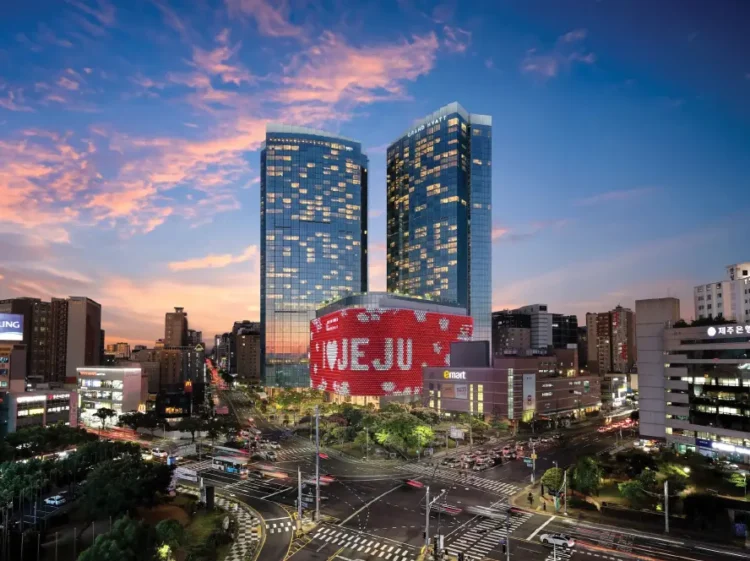
Lotte Tour Development Co, which owns Jeju Dream Tower on Jeju Island, set its own all-time revenue high in September 2025 of KRW52.9 billion (US$37.0 million) and has been hovering close to that mark ever since. Its casino revenue for the first eight months of 2026 combined is 29.4% higher than the same period last year, the operator having previously reported 61.8% growth in FY25.

Even Grand Korea Leisure (GKL), the partially state-owned operator, has enjoyed a strong rebound over the past 18 months, even if not quite at the levels it enjoyed a decade ago.
But dark clouds are on the horizon, with the impending launch of MGM Osaka in Japan threatening to hijack one of Korea’s key customer bases, and a government proposal to increase the tourism levy it charges operators on casino revenues by 50% adding further uncertainty at the worst possible time.
MGM Osaka, the massive US$10 billion development that will become Japan’s first and for now only integrated resort upon its scheduled 2030 launch, is of particular concern.

Jaehwan Kim, Chief Marketing Officer of Paradise City, stated during a panel session at the recent IAG Academy Summit in Manila that Osaka was very much front of mind for the leading Korean foreigner-only operator.
“Not just Osaka but Japan is very good at bringing tourism from their own culture. They can combine it very well,” he said. “And Osaka is already a strong destination for Asian travelers.
“When they combine this with a large-scale IR, there should be a very big impact, I think. So, we need to prepare really well.”

Jaeseok Lee, Associate Professor & Department Chair, Dept of Tourism Management Kangwon National University, explained that the worry for operators isn’t just the presence of MGM Osaka but the lack of alignment between industry and government on the threat it poses.
“Osaka has been talked about for the last decade, but still there’s a huge gap between the industry and the government side – how they perceive it or their awareness of the significance,” Lee explained. “I will say that on the government side, they are aware of it on paper but are not quite sure how it will affect the casino and the tourism industry at all.
“In practice, I think all the casino companies and casino associations are pretty much aware of the significance and are doing their research, so I would say there is a gap we need to digest.”

Chen Si, former CEO of the US$1.6 billion INSPIRE Entertainment Resort in Incheon and now COO of Singapore’s Resorts World Sentosa, points out that Japanese players account for around 50% of the revenue of Korea’s foreigner-only casinos, so any draining of the pool by MGM Osaka would be material.
While Chen remains “on the skeptical side” when it comes to how successful MGM Osaka will be – suggesting “there’s a lot of debate around whether pachinko [play] will turn into baccarat” – the impact is already being felt on the financing side, because the banks themselves have Osaka very much on their radar.
“Even today I think for Korean casinos there is an impact, because all the Korean casinos are fairly highly levered – INSPIRE, Jeju Dream Tower and even Paradise – so there’s a lot of debt from the banks,” he said.

“When you do models with the banks, Osaka is always a topic: ‘What is Osaka’s impact on the financing in Korea today?’ And because it’s now four years away, a lot of the loans are within that window, so when you do refinancing now, there’s a big variable, whether Osaka is going to take off, will it take away the Japanese business, and what’s the impact on financing? How much can you borrow, and what’s the rate?
“So, I think there is a real impact there for the operators in Korea today.”
The financing issue looms as somewhat of a double whammy for operators, many of whom are actively addressing the new regional competition by investing in substantial product upgrades aimed at enhancing their attractiveness to foreign guests.

For Paradise, this has included the US$150 million purchase of the Grand Hyatt Incheon West Tower near Paradise City to boost room count, development of a new US$400 million Seoul hotel boasting 200 suites and offering premium services for foreign VIPs, a new premium gaming area at its Seoul casino Paradise Walkerhill and rumors of more potential hotel acquisitions.
Even Kangwon Land, the only casino in South Korea at which locals are permitted to gamble, is expanding its facilities for fear that MGM Osaka could cut into its own locals market. The company has pledged to spend US$1.9 billion to transform into a world-class integrated resort, adding a new casino facility and upgraded hotel space while also expanding its non-gaming facilities by revamping walking trails around the casino complex, building a wellness center and developing a luxury pool villa, among other amenities.
Says Paradise’s Kim, “One of the strengths we are witnessing from the Korean market – Paradise, INSPIRE, Kangwon Land and also in a couple of casino properties in Jeju – they are focusing on expanding their non-gaming product and facilities, which is also in line with what the government wants.

“But in terms of the size or the experience, [learning which are the right facilities] has not yet been verified, I would say. In Osaka, we have seen that Universal Studios Japan has been very successful and has accumulated lots of visitors. The number of the visitors to Osaka is similar to visitors to Korea, so there are lots of things we need to focus on in the software, how we learn, how we operate the facility. We are still in the baby stage.”
Again, however, Chen points to financing as a growing concern.
“You have to build that ecosystem within your own facilities, but the balance between capex on gaming and non-gaming … I know that’s what the government wants, but we all know in our business that the gaming supports the non-gaming from a capital standpoint,” he says. “That means if you want excessive investment into the non-gaming part without giving more confidence on the gaming side, the investor is going to be very skeptical. And again, that leads back to the question of how you finance the projects, which is getting increasingly more difficult.”

Further complicating the issue is the fragmented nature of Korea’s casino regulation – particularly on the mainland where responsibility is owned by the Ministry of Culture, Sports and Tourism (MCST). Jeju, although still technically under the MCST’s purview, holds special status under the Jeju Special Self-Governing Province Act, which transfers a substantial portion of regulatory responsibility, including casino development and license approval, to the Jeju Governor.
Lee argues that because the MCST by its nature is more focused on social welfare than the economic stability of the foreigner-only casino industry, it can be difficult to get their full attention when it comes to the MGM Osaka impact.
Revisiting Korea’s regulatory framework, including the establishment of a dedicated casino regulatory body, would provide a far more suitable arrangement, he says.

Chen points out that the casino sector is likely viewed by the MCST as a minor portion of the broader Korea travel market, so “we can think of [Japan] as a big threat, but to the government I’m not so sure.”
Asked if Korea should review its casino and integrated resort strategy, he opines, “I think that would be great, because historically there has never really been a strategy. Different IRs and casinos were granted licenses based on different historic contexts and for different reasons. Kangwon Land was to revitalize a mining region that no longer had mines. INSPIRE was granted a license based on the Foreign Tourism Act to drive foreign tourism. And Jeju is a whole different story. They have their own mandate.
“So, nobody really thinks about gaming as a holistic industry, which makes it difficult to enhance the competitiveness of the business.

“Unfortunately, I very much doubt that will change. I think the casino sector is seen as a very small business for Korea in general – the country is much more interested in AI and technology – so it’s just not a priority in any meaningful way. Plus it’s such a political hot potato. I don’t think it’s going to be brought to the forefront of any national debate anytime soon.”
Chen echoes Lee’s concerns around the MCST’s priorities, adding that there is currently no sector expertise within the Korean government and that the MCST is itself “probably not the right place” to place regulatory powers.
“The only guy who’s always there is the slot machine inspector, and he is the only slot inspector in Korea,” Chen laughs. “Everyone depends on his schedule to make things work, and when he goes on holidays no one can do anything for any of us.”
It is in part because of this rather uncooperative regulatory structure that the Korean foreigner-only casino industry has taken such umbrage with a proposal by the MCTS to increase the maximum annual contribution payable by operators to the Korea Promotion and Development Fund from 10% to 15%, alongside a new five-year license renewal system and a prior approval system for the transfer or acquisition of significant interests in casino companies.
In the wake of the July announcement, industry analysts issued a warning that profits could be hit by as much as 37%, while industry lobby group the Korea Casino Association suggested it could hasten the bankruptcy of some companies.

While full details of how the higher levy would be implemented if it proceeds have not been released, the existing 10% levy – which is applied at an individual property level rather than per company – is based on a sliding scale whereby operators pay 1% of revenue for annual GGR up to KRW1 billion (US$737,000), 5% for between KRW1 billion and KRW10 billion (US$7.37 million) and 10% for KRW100 billion (US$73.7 million) and above. Additionally, rather than paying the accumulated amount once they cross the KRW100 billion threshold, casinos pay progressively as they pass each band and then the 10% levy on top.
Of the 17 foreigner-only casinos currently operating in Korea, it is estimated that 11 sit above the maximum threshold (although Jeju, home to eight casinos, is not currently subject to the proposed increase).
Kim, who admits to being careful what he says as a representative of Paradise, confirmed the company has shared its views on the proposal with the government. The key, he says, is “finding the right balance between supporting tourism and maintaining the competitiveness of industry.” It is “a very big issue, so maybe the government can support us.”
Lee offers a more direct assessment, describing all three tenants of the proposal – increasing the levy, implementing a license renewal system and requiring prior approval for ownership transfer – as being “on the negative side.”

He also considers the government’s take – that it is following the global regulatory trend – to be unfair, because Korea’s foreigner-only policy already places operators at a disadvantage.
“We don’t have a domestic market, so with that limitation, introducing a ‘global standard’ for the license system and the levy … it could be very difficult for operators to make that hurdle.”
Chen similarly questions the government’s motives for making such a change, even going so far as to warn that the increase places the entire ITO (International Travel Operator) segment – another term for junket – at risk.
“Because one of Korea’s distinct advantages is pricing,” he observes. “In this region, Korea along with Vietnam are the best priced operations, with revenue share at around 65% or 70% to the operator and the rest to the agent.

“So, if you take out 5% [of GGR pre-share], you no longer have a level playing field. And you lose not just a little bit, but the whole ITO segment unless you eat up the 5% on your own. So, operationally I think there will be some impact if it happens, which would again translate into the banks revising their models.
“And this is such a big variable in the model that it will have some material impact on financing.
“To be honest, I was puzzled by the announcement because Korea is about a US$2 billion market, so 5% of that is US$100 million. Does the Korean government really need US$100 million? It’s not material to them [like it is to the industry], so I don’t really know the intention behind that.”
That’s not to say it is all doom and gloom for Korea’s foreigner-only casinos. Despite the very real concerns that exist today around MGM Osaka, it is hoped that rather than cannibalize the region, the property’s opening will in fact grow the gaming pie. By introducing casino games to a broader Japanese audience, operators remain confident that a whole new generation of players will be motivated to travel abroad to try their luck in Korea.
Kim adds that, even with Osaka opening up, Korea’s competitive advantages remain – namely its unique K-Pop culture, its reputation as a safe holiday destination and, today at least, its stable relationship with the likes of Japan and China. That relations between those two nations are currently strained doesn’t hurt Korea’s appeal either.

The bigger question, of course, is whether the opening of MGM Osaka could be the catalyst for the Korean government to explore locals gaming – a move that would be a genuine game changer in every sense of the term.
“That’s the one moment we can expect [that could move the needle],” offers Lee.
“After they open, we can see how much of a contribution MGM Osaka can make to society and government and the people. That’s one of the doors that may see us rethink whether to open the domestic market or not. We missed the opportunity to open that door when Singapore arrived, so this could be the second and last chance for a bigger and better market.”
Says Chen, “Osaka will be the next milestone, but I still don’t think [locals play] will happen anytime soon.
“I know there is a lot of data around on how to effectively manage locals gaming, Singapore being a prime example of that, so there is no shortage of expertise, but the political will is quite different. Certainly, this administration. I think there is no way.
“Let’s see how the next administration plays out, but even if it happens I don’t think that will be a case of Paradise getting a license, INSPIRE getting a license. I don’t think that is going to be the way.
“I think there would be a lot more requirements coming with those licenses – maybe similar to the Vietnam model – and with a lot more additional investment required.”